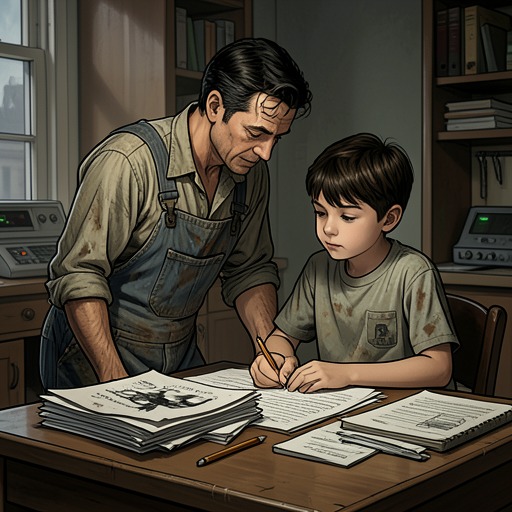
Arvind Acharya’s childhood
The Circus Vision
When [Arvind Acharya](entity:character-recall-character-arvind-acharya-f5b21d43c3ed) was about nine, he walked with his family to a circus and suddenly saw a dwarf in a red shirt fall from an elephant and die. He told his mother what he had seen before the same sequence unfolded in the tent, down to a small blue bird flying overhead.
The vision never returned, but it left him with a lasting sense that events might be predetermined. For decades he hid that experience behind the public stature of a formidable scientist.
Arvind Acharya’s youth
A Marriage of Equals
[Arvind Acharya](entity:character-recall-character-arvind-acharya-f5b21d43c3ed) married [Lavanya Acharya](entity:character-recall-character-lavanya-acharya-e2b468cd1c80) while he was a young student. Their unusual height made them a spectacle, but the practical match grew into a long marriage built around shared routines, private jokes, and Lavanya’s steady care.
He pursued physics, briefly joined [India](entity:location-recall-location-600eec71fa3c)’s early space programme, and eventually went to Princeton, where he developed his fierce opposition to the [Big Bang theory](entity:concept-recall-concept-big-bang-theory-1a7a06a0f9c8). Lavanya accompanied him through the changes in his scientific life and became his closest domestic companion.
Ayyan Mani’s early life
Ayyan’s Chawl Childhood
[Ayyan Mani](entity:character-recall-character-ayyan-mani-b778a47fc8ea) was born into the crowded, deteriorating [BDD Chawl](entity:location-recall-location-bdd-chawl-951885bef3a8), where poverty and caste shaped almost every prospect. His father was a sweeper, and Ayyan grew up seeing how privilege was inherited while Dalits were expected to remain at the margins.
He educated himself by reading whatever he could find and learned to use knowledge, humour, and guile as tools for survival. The conviction that people compete to rise above one another—and that the powerful disguise their advantages as merit—would inform his schemes throughout the novel.
Before the main story
Ayyan’s Marriage to Oja
After the deaths of his brothers and parents, Ayyan married [Oja Mani](entity:character-recall-character-oja-mani-9d5fa0a752cb), who was seventeen when she entered his one-room home. Their early marriage was marked by awkward intimacy, talk, and the effort to build a private life amid the constant presence of their neighbours.
Over time, Oja’s hopes dimmed under the pressures of the chawl, while Ayyan kept trying to enliven their life with jokes and curious facts. Their marriage would become both his refuge and the relationship most endangered by his deceptions.
Adi Mani’s early childhood
Adi’s Birth and Hearing Loss
Ayyan and Oja’s son, [Adi Mani](entity:character-recall-character-adi-mani-c991dffbc56c), was born despite Ayyan’s fear that he might not be able to father a child. As Adi grew, his parents learned that he was almost entirely deaf in his left ear and needed a hearing aid.
Oja wondered whether the family’s rejection of Hindu gods had brought misfortune, while Ayyan insisted on their Buddhist identity and resisted her wish to bring Hindu idols into the home. Their different responses to Adi’s hearing impairment exposed the fear and faith beneath their family quarrels.
Before the main story
Acharya’s Scientific Convictions
[Arvind Acharya](entity:character-recall-character-arvind-acharya-f5b21d43c3ed) became known for attacking the [Big Bang theory](entity:concept-recall-concept-big-bang-theory-1a7a06a0f9c8), which he regarded as an idea shaped by religious assumptions about creation. He later advanced Cosmic Ancestry: the belief that life’s microscopic seeds travel through space and reach worlds on meteorites.
His confidence in ideas that other scientists dismissed as eccentric brought him fame and enemies. He believed the Institute should pursue difficult questions about the origin of life rather than fashionable searches for signals from advanced civilizations.
Thirteen years before the opening
Ayyan Enters the Institute
Ayyan became a clerk at the Institute of Theory and Research, where Brahmin scientists occupied the prestigious positions and Dalits were largely confined to support work. He learned the institution’s rhythms by listening, reading, and making himself useful to people across its hierarchy.
His job gave him a close view of scientific ambition and office politics without giving him the status enjoyed by the researchers. He began to treat the Institute as a place where information could be gathered and used, not merely a sanctuary for truth.
Years before the opening
Acharya and Nambodri’s Rivalry
[Arvind Acharya](entity:character-recall-character-arvind-acharya-f5b21d43c3ed) and [Jana Nambodri](entity:character-recall-character-jana-nambodri-d2d3133b0583) had once been close friends and colleagues. Their temperaments diverged: Acharya trusted conviction and stature, while Nambodri learned to work through alliances, administration, and public relations.
Nambodri wanted the [Giant Ear](entity:location-recall-location-giant-ear-5b0f9946b4fc) used for the [Search for Extraterrestrial Intelligence](entity:concept-recall-concept-search-for-extraterre-2cdca7525be1), but Acharya opposed the programme and favoured his [Balloon Mission](entity:concept-recall-concept-balloon-mission-04b6eb253c5f). Their longstanding disagreement gradually became a struggle over authority and the future direction of the Institute.
Three months before the main action
Oparna Joins the Institute
Oparna Goshmaulik arrived from research in South America to head Astrobiology. Her appointment made her the Institute’s first female faculty member, and she quickly became the focus of attention, unsolicited advice, and scrutiny from the men around her.
[Arvind Acharya](entity:character-recall-character-arvind-acharya-f5b21d43c3ed) valued her scientific ability and gave her responsibility for the [Balloon Mission](entity:concept-recall-concept-balloon-mission-04b6eb253c5f)’s laboratory work. In the basement, however, Oparna felt both professionally isolated and exposed to the Institute’s persistent sexism.
Early in the main story
The Giant Ear Dispute
[Jana Nambodri](entity:character-recall-character-jana-nambodri-d2d3133b0583) pressed [Arvind Acharya](entity:character-recall-character-arvind-acharya-f5b21d43c3ed) to let radio astronomers use the [Giant Ear](entity:location-recall-location-giant-ear-5b0f9946b4fc) to search for signals from intelligent extraterrestrial civilizations. Acharya refused, arguing that the search was fashionable, anthropocentric, and less scientifically meaningful than investigating the stratosphere for possible microbial life.
Nambodri warned that the Institute needed funds and that scientists were becoming frustrated with Acharya’s unilateral control. Their dispute established the institutional conflict that would later give Nambodri an opening to challenge his friend.
Early in the main story
Ayyan’s Public Mockery
Ayyan used his daily responsibility for the Institute’s Thought for the Day to insert fabricated quotations that mocked Brahmin privilege and caste prejudice. He passed the inventions off as the words of famous figures, quietly turning an institutional ritual into his own small act of rebellion.
The practice reflected his suspicion that the Institute’s lofty language concealed ordinary ambition and entrenched hierarchy. It would later become a source of conflict with the new leadership.
Early in the main story
The First Secret Questions
Ayyan began giving Adi simple scientific questions to ask at school, such as why leaves were green or what gravity was made of. The boy repeated them in class, often at the wrong moment, and teachers began to treat him as unusually curious.
Ayyan and Adi made the questions their private game. Adi enjoyed the attention and began to value the identity of a remarkable boy, while Ayyan found the game a source of excitement for the family’s otherwise constricted life.
During the months before the quiz
A Genius Myth Takes Shape
Ayyan gradually made Adi’s classroom interruptions more sophisticated, supplying questions and facts for him to repeat without understanding their full context. The teachers’ growing amazement, together with Adi’s hearing aid and naturally quick mind, made the story of a child prodigy easy to sustain.
Oja worried that her son was becoming abnormal but also took pride in the attention his supposed brilliance brought. Ayyan knew the deception was dangerous, yet the family’s shared excitement made him reluctant to stop.
Early in the main story
The Ganesha Argument
Oja secretly brought a Ganesha idol home, hoping their son could know the gods and festivals familiar to other children. Ayyan found it and prepared to discard it, insisting that their family was Buddhist and that Hinduism had been used to subordinate their ancestors.
Oja answered that she felt Hindu and wanted ordinary cultural belonging for Adi. Her deepest fear was that the family’s lack of gods had somehow caused his hearing impairment, a belief Ayyan could not accept even as he understood her need for hope.
Early in the main story
The Principal’s Warning
[Sister Chastity](entity:character-recall-character-sister-chastity-0e140e52590a) summoned Ayyan over Adi’s disruptive questions and warned that the school could not tolerate his challenges to teachers’ authority. She also praised his ability and repeatedly encouraged Ayyan to consider Christian conversion, pointing to possible educational benefits for a financially disadvantaged family.
Ayyan played along with her appeals while resisting the pressure to change their identity. The meetings showed how Adi’s unusual behaviour was drawing attention from people who saw both opportunity and inconvenience in the boy.
Early in the main story
The First Institute Round Table
At the Institute’s monthly gathering, Oparna was introduced as its first female faculty member, and the scientists’ jokes made clear how unusual her presence seemed to them. The discussion ranged from Pluto to the possibility of caste-based quotas in scientific appointments.
[Jana Nambodri](entity:character-recall-character-jana-nambodri-d2d3133b0583) described his own difficult childhood as proof that Brahmins were not privileged, then invoked hard work and intelligence to dismiss structural advantage. [Arvind Acharya](entity:character-recall-character-arvind-acharya-f5b21d43c3ed)’s pointed question about Nambodri’s claimed IQ punctured the self-congratulation but did not resolve the underlying resentment.
At the first Round Table
Nambodri Challenges Acharya
[Jana Nambodri](entity:character-recall-character-jana-nambodri-d2d3133b0583) made the [Giant Ear](entity:location-recall-location-giant-ear-5b0f9946b4fc) dispute public, accusing [Arvind Acharya](entity:character-recall-character-arvind-acharya-f5b21d43c3ed) of autocratic control and warning that the radio astronomers might appeal to the Ministry. Acharya rejected the challenge and left after walking behind Nambodri in a gesture the scientists read as an orbital insult.
Oparna felt the room’s tension as a possible rebellion, while Ayyan relished the prospect of conflict between powerful Brahmins. The confrontation moved their dispute from private argument into an open contest for institutional control.
Soon after the Round Table
The Ministry’s Intervention
[Bhaskar Basu](entity:character-recall-character-bhaskar-basu-4b780af573ee) sent [Arvind Acharya](entity:character-recall-character-arvind-acharya-f5b21d43c3ed) a letter announcing that the Ministry would establish a SETI department under [Jana Nambodri](entity:character-recall-character-jana-nambodri-d2d3133b0583) and give him control of the [Giant Ear](entity:location-recall-location-giant-ear-5b0f9946b4fc). The decision would remove Nambodri’s responsibility to report to Acharya on the array’s operation.
Ayyan intercepted and read the courier before delivering it. He understood that the letter challenged Acharya’s authority and looked forward to the approaching clash, which he privately viewed as another episode in the war between Brahmins.
The day the Ministry letter arrived
The News of Gauri’s Death
Oja telephoned Ayyan in tears to tell him that her cousin Gauri had died after her husband burned her. The news brought the violence and vulnerability of women in their community into the Institute’s world of professional rivalries.
Ayyan tried to listen while scientists arrived to discuss theoretical physics. Their technical conversation suddenly seemed unreal to him beside Oja’s grief, and [Arvind Acharya](entity:character-recall-character-arvind-acharya-f5b21d43c3ed)’s anger at being interrupted ended in him driving the visitors away.
Several weeks into the genius game
The Fake Scholarship Report
Ayyan paid a small Marathi-paper reporter, Manohar Thambe, to publish a story claiming that Adi had won a Swiss science scholarship. The report said that the boy had beaten hundreds of older students and would go to [Geneva](entity:location-recall-location-634fbb9f6bb2), turning Ayyan’s private fabrication into a public achievement.
The deception gave Oja a thrilling glimpse of a different future for her son. Ayyan bought every copy he could find and watched the story spread through the chawl, while knowing that the supposed scholarship and contest were invented.
The morning after the report appeared
The Scholarship Story Reaches Home
Ayyan showed Oja the newspaper story, and she broke down with happiness as she saw Adi’s photograph and imagined his future. The neighbours gathered around the report, congratulated the family, and asked Ayyan how they could help their own children become clever.
The fabricated honour gave the family a brief public celebration and made Adi’s supposed genius seem increasingly real. At the school, Adi continued to disrupt lessons, including by asking why pupils learned decimal arithmetic but not binary.
After the scholarship report
Acharya Backs Adi
Ayyan brought the newspaper clipping to [Arvind Acharya](entity:character-recall-character-arvind-acharya-f5b21d43c3ed), who was impressed by the boy’s apparent achievement and asked to meet him. Acharya advised Ayyan to give Adi plenty of books, including comics, and not to force him into a conventional career.
For Ayyan, the attention from the Institute’s great scientist strengthened the fiction he had built. It also drew Adi closer to the adult world of science and made his imagined future feel more consequential.
After the scholarship story
Ayyan Bribes the Reporter Again
Ayyan met Manohar Thambe again and paid him for his work, asking whether the story could reach English-language newspapers. Thambe explained how badly paid reporters sometimes accepted money to place stories and said that a front-page appearance would cost more.
Ayyan’s efforts showed that he wanted the myth to grow beyond the neighbourhood, even as the thought of using his son made him uneasy. The game had become both a family spectacle and a gamble with consequences he could no longer fully control.
Later, after the newspaper report
The Geneva Selection Is Exposed
[Jana Nambodri](entity:character-recall-character-jana-nambodri-d2d3133b0583) and several radio astronomers read the scholarship story and asked Ayyan to bring Adi to the Institute. They were preparing for a confrontation with [Arvind Acharya](entity:character-recall-character-arvind-acharya-f5b21d43c3ed) and saw the boy as a possible symbol of scientific talent beyond the established elite.
Ayyan’s son was invited into the Institute’s world, but the underlying Swiss contest did not exist. The false report would later give the scientists a way to unravel the family’s story when they began investigating Ayyan.
After Nambodri’s public challenge
The Ministry Retreats
[Bhaskar Basu](entity:character-recall-character-bhaskar-basu-4b780af573ee) arrived at the Institute to implement the Ministry’s decision, but a call from a senior official changed the situation. He announced that the proposed SETI department and transfer of the [Giant Ear](entity:location-recall-location-giant-ear-5b0f9946b4fc) would be dropped while [Arvind Acharya](entity:character-recall-character-arvind-acharya-f5b21d43c3ed) remained opposed.
[Jana Nambodri](entity:character-recall-character-jana-nambodri-d2d3133b0583)’s challenge collapsed, and Acharya told him to leave the Institute. The episode ended the immediate power struggle but deepened the bitterness between the two old friends.
After the failed power challenge
Ayyan’s Private Plan
Ayyan realized that Adi was becoming comfortable with the role of a genius and sometimes forgot that the questions were a game. He feared that his son might be harmed by the myth, but he also depended on its excitement to make family life feel less trapped and predictable.
He decided that the fiction must eventually end, yet he began to imagine making it larger first. His affection for Oja and Adi, his frustration with poverty, and his appetite for spectacle pulled him in opposing directions.
Several months into the story
The Quiz Invitation
[Sister Chastity](entity:character-recall-character-sister-chastity-0e140e52590a) asked Ayyan to let Adi appear as a special participant in St Andrew’s inter-school science quiz after the school’s own teams failed to qualify. Ayyan warned that the audience might suspect that a host-school boy had been given the questions in advance.
When Sister Chastity stepped out, Ayyan searched her desk and arranged a way to listen to the quiz committee’s conversation. He captured only a handful of questions, but the opportunity gave him a new means to make Adi’s reputation appear extraordinary.
The day of the inter-school quiz
Adi’s Quiz Performance
At the crowded school auditorium, Adi called out answers before the contestants could respond, astonishing the audience. He identified the neutron and Isaac Newton, then was led from the hall after interrupting once more with the name Buzz Aldrin.
The audience applauded him, and Oja wept with pride. Ayyan understood that the performance had made the hoax much harder to contain, but he also saw how profoundly the spectacle had changed his wife’s sense of what their life could be.
After the school quiz
The Times Reporter’s Offer
Ayyan met Anil Luthra, the Metro Editor of [The Times of India](entity:organization-recall-organization-the-times-of-ind-f9b1a1cb2fae), after the quiz. He claimed that Adi could recite the first thousand prime numbers, and Luthra offered to send a reporter when the boy was ready to demonstrate it.
The claim was another deliberate invention, but it gave Ayyan a route into national media. Oja remained thrilled by the attention, while Adi’s identity as a genius became increasingly difficult to separate from the family’s secret game.
Soon after the quiz
The Prime Number Demonstration
Ayyan coached Adi to recite the first thousand prime numbers through a concealed Walkman earpiece linked to a list. A feature writer and photographer recorded the demonstration, while Ayyan tried to keep the hearing aid out of the photographs and controlled the timing of the performance.
The boy completed the recital with the hidden assistance, and the story appeared in [The Times of India](entity:organization-recall-organization-the-times-of-ind-f9b1a1cb2fae) as proof of his remarkable memory. The article’s photograph accidentally showed the hearing aid on the wrong side, leaving a small inconsistency that would later attract scientific scrutiny.
After the prime-number article
The Institute Celebrates Adi
The article circulated through the [BDD Chawl](entity:location-recall-location-bdd-chawl-951885bef3a8), where neighbours gathered to hear Ayyan explain what prime numbers were. He felt their respect and used the attention to argue that the residents should accept a builder’s offer and seek better homes for their children.
At the Institute, [Jana Nambodri](entity:character-recall-character-jana-nambodri-d2d3133b0583) invited Adi to meet the scientists. The boy said he wanted to become a scientist and join the Institute, making the adults’ interest in him a powerful new part of the myth.
During preparations for the Balloon Mission
Acharya and Oparna Grow Close
As work on the [Balloon Mission](entity:concept-recall-concept-balloon-mission-04b6eb253c5f) accelerated, [Arvind Acharya](entity:character-recall-character-arvind-acharya-f5b21d43c3ed) and Oparna Goshmaulik spent long hours together. Their professional partnership grew intimate through shared work, quiet conversations, and a mutual fascination that neither initially named.
Oparna had found Acharya’s indifference to her appearance unusually comforting, while he became increasingly conscious of her youth and presence. Ayyan noticed the change from the anteroom and understood that something personal was developing between them.
During the monsoon season
The First Confession of Desire
One late night, [Arvind Acharya](entity:character-recall-character-arvind-acharya-f5b21d43c3ed) remarked on Oparna’s hair, and she realized that she wanted him to notice her. Their attraction had become mutual, though both were aware of the difference in age, status, and the life Acharya already shared with Lavanya.
Oparna later told him directly that she could not sleep because of him. Acharya, startled by the force of his own feelings, tried to retreat into work and scientific problems but could no longer dismiss the attachment as a passing distraction.
A night during the monsoon
Oparna Invites Acharya
Oparna left [Arvind Acharya](entity:character-recall-character-arvind-acharya-f5b21d43c3ed) a sealed, scented envelope of photographs and told him to come to the basement laboratory at ten the following night. He kept the envelope unopened for a time, understanding that accepting it would mean accepting the affair.
Acharya’s anticipation competed with guilt about Lavanya, whose ordinary presence had sustained him for decades. Even as he hesitated, he prepared himself to meet Oparna in the deserted laboratory.
The night of the arranged meeting
Acharya Turns Away
[Arvind Acharya](entity:character-recall-character-arvind-acharya-f5b21d43c3ed) reached the basement laboratory intending to meet Oparna, but memories of Lavanya and their early marriage overwhelmed him. He turned away from the laboratory door and went home instead.
That night, Lavanya told him that her sister Anju had died and that she needed to travel to [Madras](entity:location-recall-location-2f502e037d6d). Acharya accompanied her to the airport, and their shared grief briefly brought the familiar intimacy of their marriage back into view.
After Lavanya leaves for Madras
The Affair Begins
With Lavanya away, [Arvind Acharya](entity:character-recall-character-arvind-acharya-f5b21d43c3ed) went to Oparna in the basement laboratory, and the two began their physical affair. Their intimacy quickly became a private world of late nights, conversations, and shared meals inside the otherwise deserted Institute.
Oparna asked Acharya about his ideas on physics and consciousness. He spoke of Benjamin Libet’s experiments and told her the childhood story of his circus vision, revealing a private belief in predestination that he had never openly discussed.
During the affair
The Universe’s Hidden Purpose
In the basement, [Arvind Acharya](entity:character-recall-character-arvind-acharya-f5b21d43c3ed) told Oparna that physics had to change and make room for life and consciousness. He believed the universe might have a purpose and that life concentrated energy into consciousness more efficiently than immense lifeless worlds could.
Oparna listened with affection and skepticism, recognizing that his ideas reached beyond accepted physics. Their conversations made their affair more than a physical escape, even as Acharya’s commitments at home remained unresolved.
About two weeks after leaving
Lavanya Returns
Lavanya returned from [Madras](entity:location-recall-location-2f502e037d6d) early and found [Arvind Acharya](entity:character-recall-character-arvind-acharya-f5b21d43c3ed) wet from the rain. When she teased him about smelling of deodorant, he admitted that he was having an affair with Oparna, who worked at the Institute.
Lavanya was stunned, but her first reaction was not the grief Acharya expected. She questioned what their marriage had meant and whether she felt the sadness she thought she ought to feel, while also recognizing her compassion and enduring love for the man he had been.
The days after Lavanya’s return
The Lovers Separate
After Lavanya came home, [Arvind Acharya](entity:character-recall-character-arvind-acharya-f5b21d43c3ed) stopped meeting Oparna alone and tried to confine their conversations to work. Oparna experienced his withdrawal as a humiliating rejection and repeatedly sought an explanation.
Acharya eventually told her the relationship could not continue. Oparna left the room in tears, then returned later to say she would help finish the [Balloon Mission](entity:concept-recall-concept-balloon-mission-04b6eb253c5f) and that they would see what happened afterward. Their attachment remained unresolved, but its easy secrecy was gone.
The first week of November
The Balloon Mission Launch
[Arvind Acharya](entity:character-recall-character-arvind-acharya-f5b21d43c3ed)’s high-altitude balloon rose from the [Hyderabad balloon launch site](entity:location-recall-location-67154b94c080) carrying four sterilized samplers designed to capture air at forty-one kilometres. The mission aimed to test his belief that microscopic organisms could arrive from space on meteorites.
Three samplers went to laboratories in Boston and [Cardiff](entity:location-recall-location-3c79e72aefef), while the fourth was brought to the Institute for Oparna’s team to study. Acharya’s long-standing scientific conviction had become a major institutional project, with the future of his reputation increasingly tied to its results.
Several weeks after the launch
Oparna Finds No Life
Oparna and her team examined the sampler returned to the Institute, with two American scientists supervising parts of the analysis. Their tests found no life in the collected air, and the result meant that the mission had not confirmed Acharya’s theory.
Oparna remained in the laboratory for days, repeating tests because she could not bear to see Acharya disappointed. Her professional diligence became entangled with her feelings for him, setting the stage for the decision that would transform the project into a scandal.
Before the Institute’s announcement
Oparna Contaminates the Sampler
After several days of fruitless testing, Oparna became angry at herself for continuing to work to make Acharya happy. In a secret act of love, resentment, and revenge, she contaminated the sampler with microbial cultures available in the laboratory.
The contamination produced apparent evidence of a rod-like bacillus and a fungus. Oparna’s action created the false result that would first make Acharya famous and later expose him to accusations of scientific fraud, even though she would ultimately insist that he had not ordered it.
A December afternoon
The Discovery Is Announced
Oparna emerged from the laboratory with a report claiming that living cells had been found at forty-one kilometres. [Arvind Acharya](entity:character-recall-character-arvind-acharya-f5b21d43c3ed) received the news in a long silence, then authorized a press release announcing the discovery of a rod-like bacillus and [Engyodontium albus de Hoog](entity:creature-recall-creature-engyodontium-albus-d-806369d7e50c).
The Institute presented the result as evidence that organisms were falling from space and that life on Earth might have extraterrestrial origins. Scientists gathered to congratulate Acharya, and Ayyan, moved by their shared wonder, briefly accepted that the pursuit of truth mattered more than his own grievances.
The day of the announcement
Acharya’s Public Triumph
At a press conference, [Arvind Acharya](entity:character-recall-character-arvind-acharya-f5b21d43c3ed) described the organisms and stressed that their extraterrestrial origin was a reasonable interpretation rather than a proven conclusion. He credited Oparna as the project coordinator, although she chose not to attend the event.
The discovery brought Acharya the recognition he had long sought for his ideas about life from space. The Institute’s scientists celebrated him, while the wider public gave the news only brief attention among the day’s other headlines.
Two to three months after the announcement
The External Labs Find Nothing
[Boston University](entity:location-recall-location-0ed442fcc880) reported that it had found no life in its sampler, and [Cardiff](entity:location-recall-location-3c79e72aefef) later delivered the same result for the two remaining samples. The discrepancy left the Institute’s positive finding vulnerable to questions about contamination.
[Arvind Acharya](entity:character-recall-character-arvind-acharya-f5b21d43c3ed) publicly accepted the obligation to report the negative results and insisted that the Institute’s laboratory had maintained proper standards. Oparna kissed him on the forehead with the calmness of farewell, and he sensed that their relationship and the mission were approaching another crisis.
After the external results
Oparna’s Accusation
Oparna sent [Bhaskar Basu](entity:character-recall-character-bhaskar-basu-4b780af573ee) a detailed letter alleging that [Arvind Acharya](entity:character-recall-character-arvind-acharya-f5b21d43c3ed) had pressured her to contaminate a sampler and fabricate the positive findings. She offered to take responsibility and resign, while the Ministry began arranging an internal inquiry.
[Jana Nambodri](entity:character-recall-character-jana-nambodri-d2d3133b0583) urged Oparna to take the allegation to the press so that it would become news before the committee could decide the case. The accusation threatened Acharya’s career and gave his institutional opponents a chance to remove him.
After Oparna’s letter
Ayyan Keeps the Recording
Ayyan had secretly recorded a conversation in which Oparna explained that she had contaminated the sampler of her own accord because she wanted to punish Acharya after their affair ended. He had not offered the recording to the inquiry when doing so might have helped Acharya.
He kept the dictaphone as leverage and waited to see how the institutional struggle developed. His silence was not an endorsement of the accusation so much as a calculated choice about which outcome would benefit him and his family.
The day of the internal hearing
Acharya Rejects the Inquiry
[Arvind Acharya](entity:character-recall-character-arvind-acharya-f5b21d43c3ed) refused to appear before the committee, sending a note that said he would not be interrogated by bureaucrats and subordinates and that his past should serve as his defence. Oparna repeated her allegation but acknowledged that she had no direct proof that he had instructed her to tamper with the sampler.
The committee broadened the proceedings to include complaints from scientists who said Acharya had humiliated them. [Jana Nambodri](entity:character-recall-character-jana-nambodri-d2d3133b0583) used the wider resentment to shift the inquiry away from the fragile evidence about the sampler and toward Acharya’s reputation and conduct.
The evening after the hearing
Acharya Is Suspended
[Bhaskar Basu](entity:character-recall-character-bhaskar-basu-4b780af573ee) announced that [Arvind Acharya](entity:character-recall-character-arvind-acharya-f5b21d43c3ed) had confessed to ordering the falsification, despite Acharya’s continued denial. Basu also cited complaints about the Director’s behaviour and his use of the basement, then suspended him and elevated [Jana Nambodri](entity:character-recall-character-jana-nambodri-d2d3133b0583) to acting Director.
The public account spread faster than Acharya’s attempts to contest it. His scientific reputation collapsed, his allies distanced themselves, and the Institute’s authority passed to the men who had long resented his dominance.
After his suspension
Acharya Attempts Suicide
Overwhelmed by disgrace and emotional numbness, [Arvind Acharya](entity:character-recall-character-arvind-acharya-f5b21d43c3ed) climbed onto the balcony railing of his home and considered jumping. He began thinking about the mysteries he still wanted to understand and about whether Lavanya would be better off after his death.
He regained his balance and recognized that what had collapsed was his public stature, not his mind or spirit. Freed, in his view, from the burden of maintaining his reputation, he began to imagine pursuing questions about life and consciousness openly.
After the suspension
Acharya Returns to the Institute
[Arvind Acharya](entity:character-recall-character-arvind-acharya-f5b21d43c3ed) began returning to the Institute as a wandering presence, speaking with students and researchers on the lawns and by the sea. He discussed the future of physics, extraterrestrial life, and his belief that the universe might be understood through the unfolding of life.
His informal audiences grew, even as his former office was remade for [Jana Nambodri](entity:character-recall-character-jana-nambodri-d2d3133b0583)’s leadership. Acharya’s loss of authority did not erase his influence; it freed him to speak without protecting the dignified image that had once constrained him.
After Acharya’s return
Ayyan Reveals His Knowledge
Ayyan told [Jana Nambodri](entity:character-recall-character-jana-nambodri-d2d3133b0583) that he had heard Oparna admit she contaminated the sampler without Acharya’s instruction. He explained that a fallen hairclip had kept the door from closing, allowing him to overhear the conversation.
Ayyan said he had withheld the truth because he wanted Nambodri to take charge of the Institute. He then asked whether Adi could take the [Joint Entrance Test](entity:concept-recall-concept-joint-entrance-test-c06b6ff45dbe), although he knew the boy was not likely to pass it unaided.
Soon after Ayyan’s disclosure
Nambodri Approves Adi’s Application
[Jana Nambodri](entity:character-recall-character-jana-nambodri-d2d3133b0583) agreed to let Adi apply for the Institute’s entrance test, presenting the decision as a chance for a gifted boy. Newspapers and television covered the application, and Nambodri appeared publicly with Adi.
Ayyan’s ambition was to turn the boy’s application into another public event and revive the family’s excitement. Nambodri’s consent also gave Ayyan a path toward a more consequential scheme involving the examination itself.
After Adi’s application becomes news
The Minister Visits the Chawl
Ayyan arranged for [S. Waman](entity:character-recall-character-s-waman-4da2d66eb4cf) to visit the [BDD Chawl](entity:location-recall-location-bdd-chawl-951885bef3a8), where the minister praised Adi as a future Dalit liberator and presented the family with a computer. Waman also promised to help residents negotiate a better price for their homes with builders.
The ceremony brought prestige and attention to Ayyan’s family, but it also made him uneasy: a powerful politician with a violent past now knew his son by name. After the minister left, Ayyan told Adi once more that the genius game was over and that the boy would not take the entrance exam.
After the minister’s visit
The Genius Game Ends
Ayyan told Adi that he was not smart enough to pass the entrance test and that the family’s elaborate game had ended. Adi accepted the decision but admitted that other boys called him deaf, revealing how much the false distinction of genius had protected him from feeling marked by his hearing loss.
Ayyan tried to comfort him with jokes and familiar affection. The promise to stop the deception, however, would soon be compromised by Ayyan’s fear that ordinary life offered his son too little opportunity.
Weeks before the Joint Entrance Test
Ayyan Plots the Exam Heist
Ayyan investigated the Institute’s examination arrangements and learned that three versions of the [Joint Entrance Test](entity:concept-recall-concept-joint-entrance-test-c06b6ff45dbe) had been printed for the Institute through [Aryabhata Tutorials](entity:organization-recall-organization-aryabhata-tutori-c038b178c621). He searched offices and questioned staff but could not find the papers, which had been secured at the [Bhabha Atomic Research Centre](entity:location-recall-location-30675ef6a9ca).
The discovery that the papers were beyond his reach did not end the plan. Ayyan realized that [Arvind Acharya](entity:character-recall-character-arvind-acharya-f5b21d43c3ed), who had helped compose the exam, might remember the questions and provide another way to give Adi a chance.
After Lavanya leaves home
Acharya Occupies the Basement
As [Arvind Acharya](entity:character-recall-character-arvind-acharya-f5b21d43c3ed)’s unconventional happiness and behaviour became difficult for Lavanya to bear, she left for Chennai. Acharya withdrew to the basement laboratory, where students and scientists gathered to hear him speak about physics, life, and the universe.
When management ordered him to leave, the visitors dispersed, but security guards and Ayyan helped him remain on the premises. The basement became his refuge and a makeshift centre for the scientific community that still wanted to listen to him.
During Acharya’s basement occupation
Ayyan Bargains with Acharya
Ayyan visited [Arvind Acharya](entity:character-recall-character-arvind-acharya-f5b21d43c3ed) in the basement and asked for the location of the [Joint Entrance Test papers](entity:object-recall-object-b753b7797c0f). Acharya refused to help until Ayyan played the secret recording of Oparna explaining that she had contaminated the sampler herself.
Ayyan offered to help Acharya regain a working life at the Institute in exchange for the exam questions. Acharya agreed to write down what he remembered, turning the old secretary’s leverage and the disgraced scientist’s memory into a new collaboration.
Before the Joint Entrance Test
Acharya Writes the Exam
[Arvind Acharya](entity:character-recall-character-arvind-acharya-f5b21d43c3ed) reconstructed more than two hundred questions from the three versions of the exam and wrote them out for Ayyan. He warned that forty correct answers would already be an exceptional score and that Adi should attempt no more than forty questions to avoid suspicion.
Ayyan intended to use the answers to create a public sensation, not simply to secure his son’s admission. Acharya’s cooperation tied his own possible return to the Institute to an act of examination fraud.
On the examination day
Adi Takes the Joint Entrance Test
Oja prepared Adi carefully for the exam, oiling and bathing him before sending him off with Ayyan. She cried at the door, while Adi asked his father whether she could come with them.
Neighbours followed the father and son through the chawl and toward the examination, turning the boy’s attempt into a public event. Adi sat the test with the questions and answers supplied through Ayyan’s arrangement.
After the Joint Entrance Test
Adi Passes the Exam
Adi scored thirty-nine answers correctly, placing him among the leading candidates. Ayyan announced that the boy would not attend the remaining interview, explaining that he should finish school first and that the Institute’s scandal made it an unsuitable place for him.
At a press conference arranged with [S. Waman](entity:character-recall-character-s-waman-4da2d66eb4cf), Ayyan also said he had evidence explaining what happened in the sampler affair. He promised to play recordings that would expose the Institute’s conduct, turning the boy’s success into the occasion for a broader public reckoning.
The day of the press conference
Ayyan Plays the Recordings
Ayyan released the recording of Oparna explaining that she had contaminated the sampler without [Arvind Acharya](entity:character-recall-character-arvind-acharya-f5b21d43c3ed)’s instruction. He also played the recording of [Jana Nambodri](entity:character-recall-character-jana-nambodri-d2d3133b0583) and other scientists making racist and casteist claims about Dalits, women, and inherited intelligence.
The remarks spread across television news, transforming the scandal. The Institute’s leaders now faced public exposure not only over the disputed discovery but also over the prejudice that shaped their private conversations.
During the press conference fallout
The Hoax Is Uncovered
[Professor Jal](entity:character-recall-character-professor-jal-3818fe57f894) presented evidence that Adi had not won the Swiss contest and that the newspaper’s prime-number demonstration had been staged. He pointed to the reversed hearing-aid in the photograph and to a printer’s memory of a call about the examination papers.
The radio astronomers concluded that Ayyan had fabricated the genius story and arranged Adi’s exam score. [Jana Nambodri](entity:character-recall-character-jana-nambodri-d2d3133b0583) confronted Ayyan, but Ayyan warned him that the Institute was no longer safe and refused to confess.
That afternoon
The Institute Riot
A mob gathered outside the Institute after the recordings circulated, and stones shattered the windows as the radio astronomers tried to protect themselves. Men with iron rods entered the building and beat the scientists, while the Institute’s workers had already gone on strike.
The assault spread into wider protests and violence across the city before the unrest receded. The spectacle destroyed the sense of security around Nambodri’s new administration and forced the Institute to confront the public consequences of its private bigotry.
After the riots
Acharya Returns to Work
In the aftermath of the scandal and violence, [Arvind Acharya](entity:character-recall-character-arvind-acharya-f5b21d43c3ed) regained a place at the Institute. [Lavanya Acharya](entity:character-recall-character-lavanya-acharya-e2b468cd1c80) helped restore his office, though she allowed only a Carl Sagan poster on its otherwise blank walls.
She returned to his life and asked Ayyan to take care of him. Acharya’s scientific work and public standing remained altered, but the household bond with Lavanya survived his affair and disgrace.
Near the ending
Ayyan’s Final Prank
At Worli Seaface, Ayyan showed Adi a spoon and asked whether he wanted to bend it with his mind. He told the boy that this would be the very last time they played a trick together.
Adi agreed, and father and son laughed at the prospect. The ending leaves them poised between the old deception and a smaller, more intimate game, with no claim that their difficult lives have been transformed.